Archived owner experience describing a period standalone-ECU conversion and tuning configuration. Do not treat historical boost/tuning settings as a safe modern calibration recommendation.
Procedure
The saga of fitting a MOTEC M600 ECU to my Audi UrS4
Tony Guttmann
December 12, 2005
The Patient
A 1994 UrS4, right-hand drive, living happily in Australia. The car has 57,000 miles on the odome- ter (91,000 km), and has the following modifications: RS2 Exhaust manifold RS2 Turbo Lucas Delphi injectors Waste gate screw turned down 3.5 turns Samco hoses 3 inch locally made exhaust system with cat, 3 resonators and a lightly baffled rear muffler.
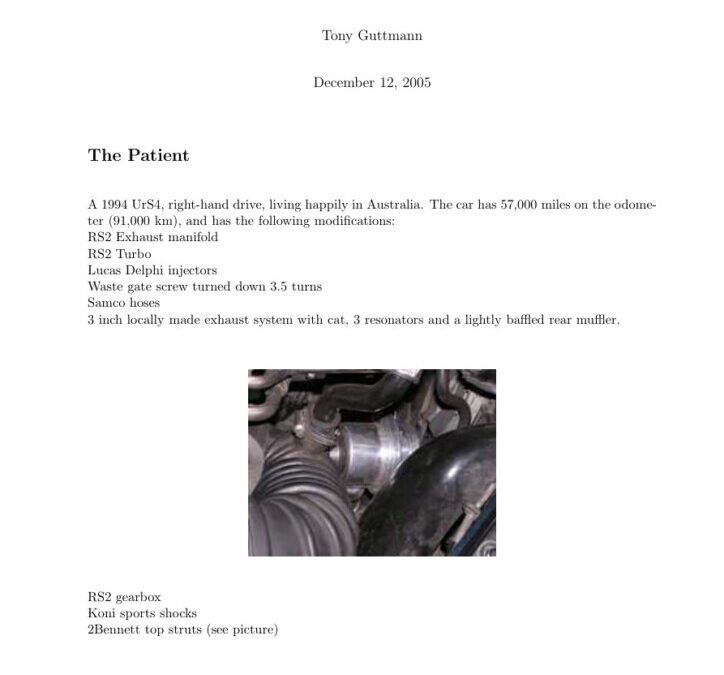
RS2 gearbox Koni sports shocks 2Bennett top struts (see picture)
Cams, head gasket, air filter etc. all original.
The Symptoms
Not enough power. Unsatisfactory drivability. For more than a year I have been trying to find appropriate chips, but without success. The chips I tried never seemed to suit the car, and, on dyno testing, always had excessively rich AFR ratios and excessively low power. I concluded that it is not possible to chip tune my car without someone locally doing some hands-on programming, and there is no-one I know in Australia with that expertise. Given that there are, I believe, 18 UrS4s in the country, this is perhaps not surprising.
The Treatment
Fit a MOTEC M600 ECU in place of the Motronic ECU. MOTEC’s are made here in Australia, and there is local expertise in setting them up.
The Doctor
Neil Trama, of Queanbeyan, NSW has a long history of MOTEC installations, including a number of rally and race cars, as well as his own concourse winning Audi 90 quattro. He is a qualified engineer, and loves this sort of challenge (n.*****@******du.au).
The path to robust health
I travelled to Canada and left the car with Neil to work on. Neil’s aim was to make the conversion readily backwards compatible, so step one was to buy a cheap BMW 318i ECU which had the same plug as the S4 Motronic ECU. This was gutted to provide a chassis and plug for the MOTEC (see pictures).
The aluminium cover was deliberately left offthe chassis to aid cooling of the MOTEC ECU. The 3 bar sensor is the black blob atop the ECU. It can be replaced by a 5 bar sensor by the brave (or foolish) who seek such levels of boost. Next, the oxygen sensor was replaced by a wide-band OXS that works with the MOTEC (see picture).
(The green wire goes to an exhaust gas temperature probe, used in earlier testing, and since removed). Finally, the MAF was removed, and replaced with a tube of the same external shape that Neil turned from a solid block of industrial strength Nylon (see picture).
The plan was to use all original sensors and gauges, as far as possible. The first set-back came when Neil discovered that the latest MOTEC software did not support a 135 tooth fly-wheel (the older software, for the M4 as on his quattro did support that tooth number). While this could have been accommodated by making the sensor non-standard, this would have defeated the intention of an easily backwards-compatible installation. Instead, we waited 3 weeks while MOTEC produced a new version of their ECU software that supported a 135 tooth flywheel. Further fiddling was necessary to get the tachometer working. The digital boost gauge and fuel consumption displays do not work, as a result of this conversion (but all this data is logged by the ECU, and can be downloaded onto a laptop).
Then came extensive on-road tuning. When I collected the car, Neil commented that he didn’t understand why the oxygen concentrations at the turbo outlet and at the tail-pipe were identical. This suggested to him a malfunctioning cat, a conclusion he thought strengthened by the excessive quietness of the car.
I nevertheless drove it home to Melbourne (some 650 km), and was delighted with the performance. 80-120kph in gears ran 3.1/4.25/6.1/8.5 sec in 3/4/5/6 gear, on a 25 deg (Celsius) (77 F) day, with driver plus luggage on board, with excellent drivability. Fuel consumption was exactly 10l/100km. (The conversion to weird US units is left as an exercise for the reader). I drove at about 120 kph all the way, plus some city driving, and quite a few short acceleration runs.
I took the cat to be checked and found it was half burned out and half blocked, a consequence of the excessively rich mixtures of the chipped car. With a new cat, the dyno run was aborted at 3800 rpm as the MAP flew past 300kPa with the unblocked cat. To my great good fortune, Neil was visiting Melbourne just a day later, and we spent three hours on a back road going faster than I am prepared to admit in print while Neil re-mapped the MOTEC.
The result
The car flies when it hits 3300. The 80-120 kph times are now (3.0/4.1/6.8/8.9) in gears 3/4/5/6. I am confident of improving the gear 5/6 response. Other figures are 60-80 mph in gears. I’ve only got 3rd and 4th gear times, which are 2.77 and 3.87 sec respectively, compared to an RS2 4th gear
time of 3.73 sec. The car is extremely drivable and responsive. Boost starts gently at 2500 rpm. My mechanic, who thinks I am an idiot to have started down the slippery slope, was impressed for the first time, and said he wanted the first opportunity to buy the car, should I ever decide to sell.
The next step
Performance below 3500 can be improved. The 3.5 turns on the waste-gate means that the electronic boost control’s resolution is too coarse. This will be adjusted and low rpm boost improved. I am currently running just on 3 bar boost. (The MOTEC will support a 5 bar sensor, should I so wish, but is currently fitted with a 3 bar sensor. The sensor is externally mounted and is a snap to change). Even with 3 bar and the current settings, I am pushing the limits of my stock intercooler and fuel delivery system. After just one solid run, intake temperatures are up from 35 deg. C to 60 deg. C. To protect my engine, Neil has programmed in a pretty aggressive map, that retards the ignition and lowers the boost levels very quickly as air intake temperatures exceed 50 deg. C. This makes it difficult to do an accurate dyno run (especially as it is currently summer in Australia), as the intake temperatures quickly rise above 50 deg. C. The solution, presumably, is an FMIC, but I can’t see me needing this, except for bragging rights. Secondly, the fuel delivery system seems to be at the limit of its operating cycle. The fuel pump is original. I propose to try the celebrated D. Forgie direct wiring to the fuel pump route to pick up an extra volt or so. And if Santa delivers a FMIC, I guess it would be churlish not to install same.
The Conclusion
A great result, at a not insignificant cash outlay. But it’s transferable to any other car (with no more than 6 cylinders). It is also much more readily modifiable than a Motronic ECU, unless you know someone at Bosch who will give you the codes (about as likely as Bill Gates giving you source code for their operating system). It should also be pretty much plug and play for anyone with a similar mechanical set-up.
Related Tech Tips
Revision History
- — Updated
